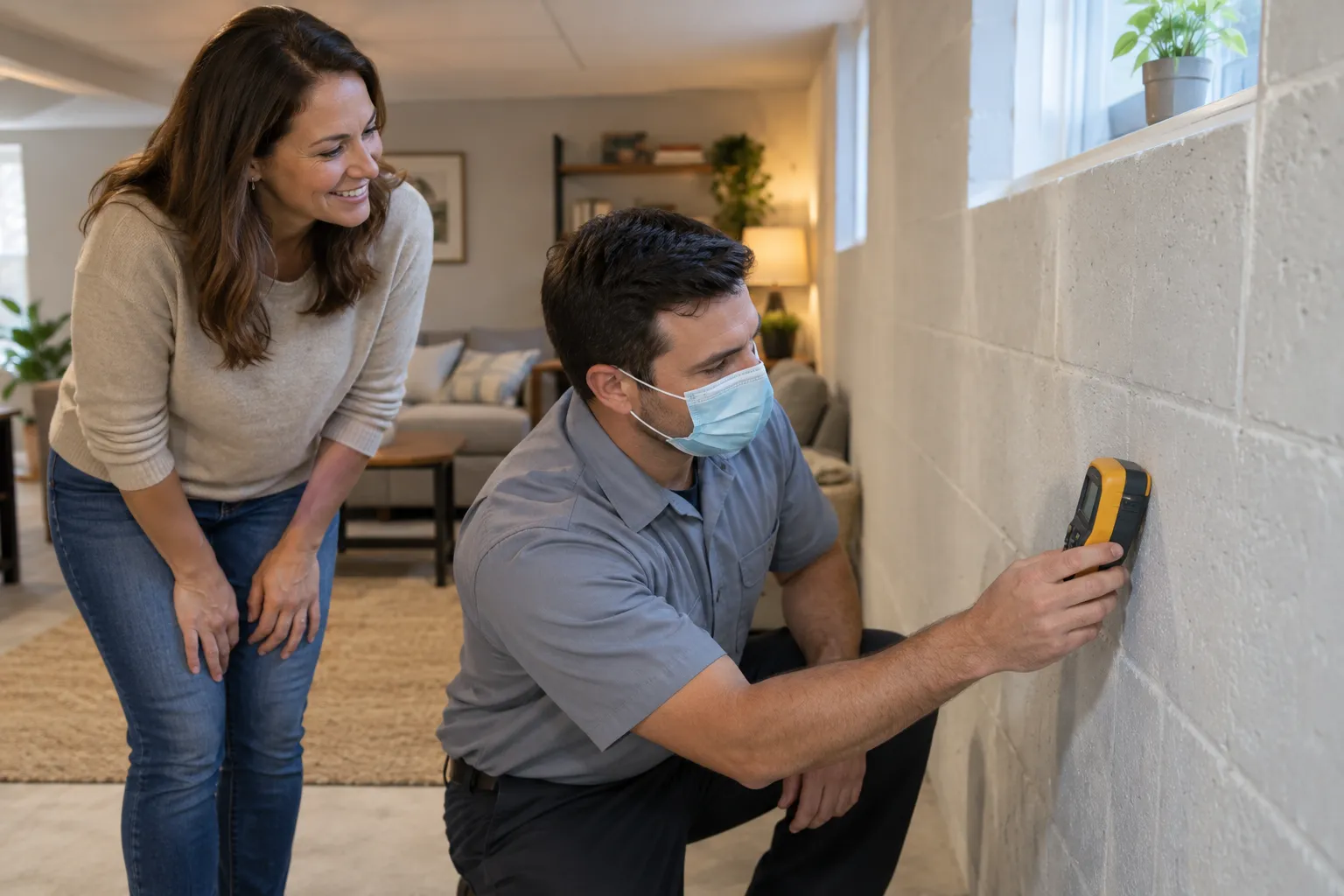
What a Mold Provider Visit Looks Like in Salt Lake City
Knowing the sequence helps you spot a thin quote or a skipped step. This guide walks through a typical mold job from first contact to final check. Details differ by provider, so treat it as a framework for your own questions.
Step 1: Your request
You submit the request form with your address, a description of the problem and any photos. Specialahead Mold Help is a referral site. It does not do the work and does not set prices. Your details are routed to an independent provider that serves your part of the Salt Lake City area, and that provider replies to you directly.
Availability depends on the provider. If your address is at the edge of the area, expect that matching may take longer.
Before you submit, gather what you know: where the problem is, roughly how large it is, when you noticed it, and any recent leak, storm or heavy melt.
Step 2: The inspection visit
The provider walks the home and checks the affected area. A thorough visit usually includes:
- Visual review of walls, ceilings, floors and framing where accessible
- Moisture readings on surrounding materials
- A search for the water source, such as a roof leak, plumbing drip, foundation seepage or poor venting
- Photos for the file
- Possibly air, surface or bulk samples, if you or the provider decide testing is useful
Expect questions. How long has the area been damp? Has it been cleaned before? Is anyone in the home sensitive to dust or odors? Honest answers help the provider scope the work.
Step 3: The written scope and quote
Ask for a written scope before you agree to anything. It should state:
- The area to be treated, in rooms or square feet
- What materials will be removed and what will be cleaned
- The containment and air filtration approach
- Equipment and how it is billed
- Disposal
- Whether post-work testing is included
- What is not included, such as rebuilding or source repair
If a price arrives without this detail, ask for it. Compare quotes item by item, not only by the total.
Step 4: Fixing the moisture source
Cleaning mold without fixing the cause invites a repeat. The source may need a plumber, roofer, gutter or grading work, or better ventilation. Some providers coordinate this. Others expect you to hire a separate trade. Ask which applies and who is responsible for sequencing.
Step 5: Containment and removal
On the work day, the provider seals off the affected area, often with plastic sheeting, and may run air filtration or negative pressure so spores do not drift into the rest of the house. Affected porous material, such as drywall or insulation, is typically cut out and bagged. Hard surfaces are cleaned. The area is then dried.
You may be asked to stay out of the work zone. Ask about pets, children, HVAC use and timing before the day arrives.
Step 6: Cleaning and final checks
After removal, the provider cleans the area and surrounding surfaces and removes containment. A walk-through should confirm the visible work is done. If post-work testing is part of the plan, samples are taken after cleaning, and results come back from a lab on their own timeline.
Rebuilding is usually separate. New drywall, paint and flooring may come from the same provider or another contractor. Get that agreed in writing as well.
Questions worth asking any provider
- Who will be on site, and are they employees or subcontractors?
- What proof of license and insurance can you provide, where required?
- What does the quote include and exclude?
- How will you contain the work area?
- What is the plan if you find more damage once walls are open?
- How will we confirm the work is complete?
If something does not feel right
Pause before signing. Ask for clarification in writing. You can request quotes from more than one provider. Specialahead Mold Help can be reached at contact@specialahead.world with questions about how a request was routed, though the work, contract and pricing are always between you and the provider.
More homeowner guides
What a Mold Provider Visit Looks Like in Salt Lake City: questions
- Who actually performs the work after I submit a request?
- An independent provider that serves your area. Specialahead Mold Help is a referral site with no crews of its own. It passes your details to a provider, who contacts you, inspects the home, quotes the job and does the work under their own terms. Your agreement is with that provider.
- How long does a typical job take?
- It depends on the size of the area, the materials involved and how long drying takes. A small contained area is a shorter project than a basement. The provider should give a timeline in the written scope. Ask what could extend it, such as hidden damage found once walls are open.
- Do I need to leave the house during the work?
- Not always, but you may be asked to stay out of the work zone, and sometimes out of the home for a period. Ask the provider before the work day about containment, air filtration, HVAC use and any concerns about children, pets or sensitive household members.
Request a callback
Describe your mold problem and request an estimate. Or use Request a callback to check provider availability. A local provider in our network follows up with you directly.
No obligation